Somewhere on Block Island right now, a hand-blown glass orb is sitting within a foot of a trail. If you find it, it’s yours. No catch, no purchase, no guard — just a frosted glass float waiting in the grass, and that single fact tells you more about the unique things to do on Block Island than any ranking of its beaches ever could.
Here’s what happens when you search this island, though. You get the same five places, every time. Mohegan Bluffs. The Southeast and North lighthouses. Crescent Beach. The bike loop. Good places, all of them — and all of them already covered to death, in nearly identical sentences, by everyone.
This is the list that starts after those. Nine deep cuts for the repeat visitor and the traveler who’d rather skip the obvious — the offbeat corners, the off-season hours, the genuinely only-here stuff. And before you trust a word of it: no, there is no secret “third harbor” on Block Island, no matter what you’ve read. That one’s an April Fools’ joke a ferry company ran, and a startling number of articles repeated it as fact. Ay, no. If a piece can’t get that right, what else is it guessing at?
- The bar every item on this list had to clear
- Hunt for a glass float — the only treasure hunt like it anywhere
- Find the Painted Rock — then leave your own mark on it
- Visit the camels, kangaroos, and lemurs (yes, on Block Island)
- Walk into Rodman's Hollow, where the whole conserved island began
- Get lost on purpose in the Maze at Clay Head
- Comb the quiet coves for sea glass
- Skip the ferry and fly in from Westerly
- Stand at the Palatine graves and learn the island's ghost story
- Come in the off-season, when the island empties out and the seals move in
- What didn't make the list, and why
- What this actually costs
- Questions you're about to search anyway — FAQs
- The island worth coming back for…
The bar every item on this list had to clear
Two questions. That’s the whole filter.
First: is this thing actually Block Island, or is it just happening to sit on Block Island? A nice sunset exists everywhere. A glassblower hiding 550 numbered orbs across a seven-mile island does not. The item had to be impossible to do anywhere else, or made into something specific by this particular place.
Second: would someone who’s already been here lean forward when they read it? If a returning visitor would shrug and say “yeah, did that,” it didn’t make the cut. These are the unique things to do on Block Island for the person on their second trip — or their fifth, or the first-timer who wants nothing to do with the gift-shop circuit.
A few famous names won’t appear below, ranked or otherwise. The bluffs, the lighthouses, the main beach, the loop around the island — those are the greatest hits, and they’ve earned their fame. This piece is what comes after you’ve done them.
Also Read: 20 Best Things to Do on Block Island — the full cornerstone guide to the icons, ferry logistics and all.
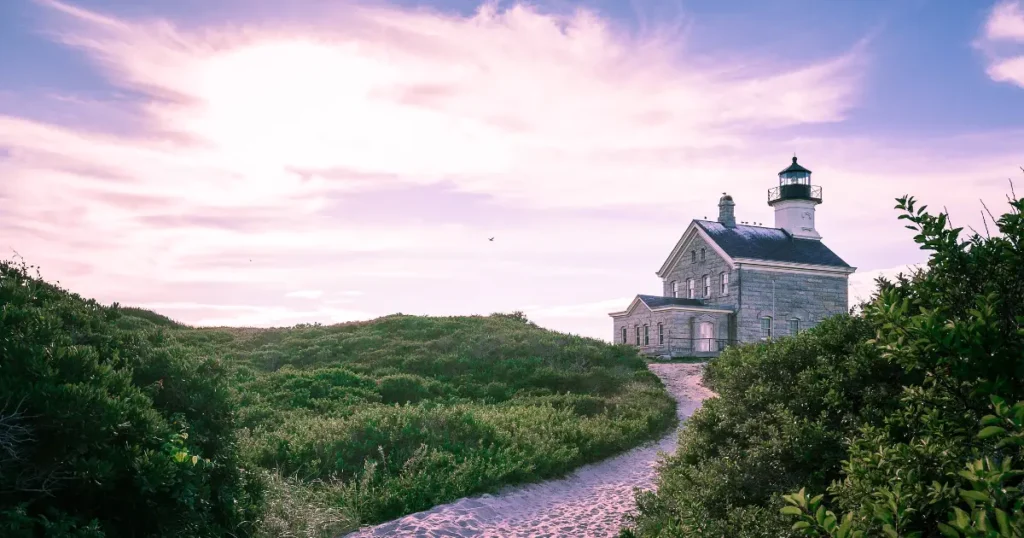
Hunt for a glass float — the only treasure hunt like it anywhere
Start here. If you do one thing on this list, make it this.
Every year, the glass artist Eben Horton and his wife, Jennifer Nauck, blow upwards of 550 glass floats at their studio, The Glass Station, in Wakefield on the Rhode Island coast. Each orb is about the size of an orange, stamped with the outline of Block Island, dated, and numbered 1 to 550. Then they’re hidden across the island, and whoever finds one keeps it. Horton started it back in 2011 — when the economy slowed and his glass got hard to sell, he made the first 150 to hide for fun, modeled on the Japanese fishing-net floats that drift up on beaches worldwide. It’s now one of the biggest reasons people come here at all.
Most floats are clear. The first couple dozen each year are made in color, and the count tracks the year, creeping up by one every January. Number 1 is always something else — made with gold leaf. People want that one badly.
The hiding is its own quiet operation. From June through October, and often past it, a team of volunteers — many of them former finders, the obsessives the island calls Orbivores — tuck the floats a few at a time onto beaches and along the Greenway trails. The rules matter: within about a foot and a half of a trail, or on open beach between the bluffs and the high-tide line, never in the dunes, never up a bluff or jammed in a stone wall, never on private land or in a cemetery. Find two in a year and you rehide the second. One float per person, per year.
Now the part the breathless write-ups skip: your odds aren’t good. The Tourism Council, which funds the project, puts the number of people hunting in a given year somewhere between 5,000 and 10,000. Against 550 floats. Te lo juro — people search for years and come up empty. Horton’s own advice for the math: look up. Some sit in branches or on posts, right where someone scanning the dirt walks straight past them.
Treat the float as the reason you’re out on the trail, not the prize you’re owed.
So walk the Greenway slowly, scan the hedgerows and low branches, and bring the kids — it’s the rare thing that turns a nature walk into a treasure map without anyone faking it. Find one, and register it with the Tourism Council online, photo and story and all. The orbs stay hidden into the cold months, too. One more reason to come when nobody else has.
Where: Greenway trails and any public beach, island-wide
When: Floats hidden June through October and often later; the hunt runs year-round
Cost: Free
Time: A slow half-day’s walk — the looking is the point
The move: Look up, not just down. Branches and posts are where the desperate ground-scanners blow it.
Find the Painted Rock — then leave your own mark on it
Near the south end of the island sits a rock that’s been painted over so many times it’s basically a logbook of other people’s good news — proposals, birthdays, graduations, the occasional goodbye. Someone drives out, paints their message, and within a week someone paints right over it. It’s been going since 1962 and has never once been finished.
The origin beats the rock. For decades nobody knew who started it; then, around 2000, the culprits confessed in a letter to the local paper. Wendy and Ed Northup, bored on Halloween night in 1962, painted it as a prank — Ed kept watch for the police chief while Wendy fetched the paint from a café in town. No words that first time, just color. Wendy Northup died in early 2024. The rock she accidentally started still gets repainted most summer weeks.
Mira — here’s what half the internet gets wrong: the Painted Rock is not on Corn Neck Road. It’s at the three-way junction of Mohegan Trail, Lakeside Drive, and Snake Hole Road, down south near the bluffs. If a blog sends you north for it, that blog has never been here.
Bring a small can of paint and leave something. It isn’t vandalism — it’s the whole tradition, and you’ve got about a week before the next person covers you.
Where: Junction of Mohegan Trail, Lakeside Drive, and Snake Hole Road, southern end
When: Year-round; repainted weekly in summer, less in winter
Cost: Free (bring your own paint)
Time: 15 minutes, more if you’re painting
The move: Catch it on the way to or from the bluffs — it’s right there — and actually leave a message. Watching it disappear is the point.
Visit the camels, kangaroos, and lemurs (yes, on Block Island)
A nine-minute walk from the ferry, there’s a free hillside farm where you can stand at a fence and watch a camel. Also kangaroos, lemurs, emus, a yak, a zebu, a one-eyed zedonk named Cindy, and a tortoise. Ay dios — on a small island off Rhode Island.
The how is a good story. In 1973, Justin Abrams bought a llama from the Bronx Zoo and brought it over to New Shoreham — the island’s official town name — and the collection grew into the menagerie behind the 1661 Inn and Hotel Manisses. Abrams died in 2016, and his family kept it running, the way a family keeps something because their grandfather loved it. There’s no admission; a bag of feed is a dollar, and the goats and emus will let you know they’re interested. In season, a food truck runs midday.
The alpacas are the move. They roam loose near the old mill at the back, and the same fleece they’re growing gets milled into yarn on the island — agritourism you didn’t plan on. Walk to the back.
One fair word: it’s a small private farm, not a slick zoo, so read it that way. By the recent accounts of people who’ve visited, the animals look well looked after. Go gently, don’t torment the camel for a photo, and it’s a genuinely odd, good twenty minutes.
Where: Between Spring and High Streets, about a nine-minute walk from the ferry
When: Year-round, dawn to dusk; food truck midday in season
Cost: Free; feed bags $1
Time: 20 to 30 minutes
The move: Head to the back fence for the loose alpacas — most people stop at the camel and miss them.
Walk into Rodman’s Hollow, where the whole conserved island began
Here’s the fact about Block Island that reframes everything else: nearly half of it is protected open space, permanently, and will never be built on. In 1991, The Nature Conservancy named it one of just twelve “Last Great Places” in the Western Hemisphere. A seven-mile island. Half of it set aside forever.
A seven-mile island. Half of it set aside forever.
Rodman’s Hollow is where that began. It’s a 230-acre glacial outwash basin — a bowl gouged by meltwater at the end of the last ice age — on the southern side, and in 1972 it became the first land islanders fought to keep wild. Everything green you pass on this trip traces back to that fight. You enter through a wooden turnstile off Black Rock Road; from there the paths drop into the hollow, in places below sea level, then climb toward the ocean at Black Rock.
It’s foot-only, no bikes, and the quiet down in the basin is a different species of quiet than the beaches. It’s also serious habitat — it shelters the northern harrier and, improbably, the only natural population of a federally threatened beetle east of the Mississippi. You won’t spot the beetle. You’ll feel the seriousness anyway.
Come in early-to-mid May, when the shadbush blooms white across the basin. Stand on the knoll, look down the hollow to the Atlantic, and you’re looking at the reason the island still looks like this.
Where: Black Rock Road, off Cooneymus Road, southern end
When: Year-round; shadbush blooms early-to-mid May
Cost: Free
Time: 1 to 2 hours to the overlook and back
The move: Walk all the way down toward Black Rock for the payoff. Most people peer in from the turnstile and leave.
Get lost on purpose in the Maze at Clay Head
Most of the island’s drama is coastal. The secret is that its most absorbing hours are inland, in a snarl of unmarked footpaths through the shrubland everyone calls the Maze.
It sits inside the Clay Head Preserve, about 190 acres on the northeast shore, reached off Corn Neck Road a couple of miles north of town — watch for the small post marker, then a dirt road to a parking area. Up top, clay bluffs drop to the ocean. Behind them, dozens of paths split and rejoin through head-high bayberry with no signs and no logic. People lose track of time in here. That’s the appeal, not a warning.
In spring and fall it’s one of the better songbird spots on the East Coast, the shrubs loud with migrants riding the Atlantic Flyway. The rest of the year it’s you, the wind, and a maze you opted into.
One note, because it earns the name: mind your turns, give yourself more time than you think, and don’t start in fading light. It’s a small preserve — you’ll always get out. Go in, take a path, take another, and let the island’s quietest hour happen to you.
Where: Off Corn Neck Road, about two miles north of town; look for the post marker
When: Year-round; songbird migration peaks spring and fall
Cost: Free
Time: 1 to 3 hours, depending on how lost you get
The move: Go in without a destination. The Maze rewards wandering and punishes a schedule.
Comb the quiet coves for sea glass
The island offers two kinds of treasure hunting. The float project is the curated one — numbered, registered, rule-bound. Sea glass is the wild one, and it needs no season, no app, and nobody’s permission.
The trick is going where the crowds don’t. The big east-side beaches get picked clean; the quieter west-side coves and the stretches near the New Harbor jetty are where the frosted glass actually turns up. Dorry’s Cove, with its darker sand, is a known spot. Free, all of it.
Time it with the tide. Low water after a blow churns up the best of it — one more reason the shoulder seasons quietly beat July here. You won’t fill a jar. You’ll pocket three or four good pieces on an empty beach, the whole cove yours. It’s the slowest thing on this list. Do it on the day you have nowhere to be.
Where: West-side coves and the New Harbor jetty; Dorry’s Cove for the darker sand
When: Year-round; best at low tide after a storm
Cost: Free
Time: An hour is plenty; let it run longer if it wants to
The move: Go at low tide the morning after rough weather — the wind does the sorting for you.
Skip the ferry and fly in from Westerly
Everybody takes the boat. You don’t have to.
New England Airlines has flown a small commuter plane from Westerly, Rhode Island, out to the island since 1970, and the flight takes twelve minutes. Twelve. You park free at Westerly, climb in, and the whole seven-mile island unrolls below you — bluffs, ponds, the green half that’s never been built — legible all at once in a way sea level and the ground simply can’t give you. A newer operator, Fly the Whale, runs the same hop now too.
It’s the rare splurge that’s also practical. Seasick easily? The plane skips the part that ruins your morning. Short on time? It collapses the crossing into a coffee’s length. Fares run around $85 each way, sometimes less round-trip — more than the ferry, sure, but you’re buying the view and the hour.
Two honest caveats: New England Airlines books by phone, not online, so call ahead; and it’s a small aircraft over open water — a thrill if you like that, not for you if small planes drop your stomach. For everyone else, it’s the best fifteen minutes of money here.
Where: Westerly State Airport, Westerly, RI (free parking)
When: Daily, year-round; weather permitting
Cost: Around $85 each way, sometimes less round-trip
Time: A 12-minute flight
The move: Book by phone — they don’t take online reservations — and ask for a window seat. The whole island is the show.
Stand at the Palatine graves and learn the island’s ghost story
Block Island earned a grim reputation among sailors — a stumbling block, the kind of place you didn’t want to wreck. The darkest version of that reputation has a marker you can stand at and a ghost attached.
The real event: in 1738, a ship called the Princess Augusta sailed from Rotterdam carrying German immigrants — Palatines, after the region they’d left, which is how the ship itself got muddled into history as “the Palatine.” Storms hammered the leaking vessel, and two days after Christmas she ran aground off Sandy Point in a snowstorm. Some of the dead were buried here. A small marker, placed in 1947, reads simply: Palatine Graves — 1738.
Then the legend took over, and it went dark. In an 1867 poem, John Greenleaf Whittier told a version where islanders lured the ship ashore with a false light, murdered the passengers, and set her ablaze — a burning ghost ship that returns each year between Christmas and New Year’s, a mad woman’s screams over the surf. Islanders were furious. Their own historian spent a decade trying to scrub the slander off their ancestors.
Here’s the discipline the ghost tours skip: it almost certainly didn’t happen that way. No wreckage was ever found. There’s real evidence the Princess Augusta was simply refloated and sailed on, and a 2017 history reconstructed the whole thing and concluded the ship was never lured, plundered, or burned. The apparition people have sworn they’ve seen off the north end since the early 1800s has no body — only believers.
Which is exactly why it’s worth your time. Stand at the marker on a grey winter afternoon, the island half-empty and the wind doing its work, and you’ll feel the pull of the story knowing it’s mostly invention. That gap — between what happened and what people needed to believe — is the most interesting thing on this island that isn’t made of glass.
Where: The “Palatine Graves — 1738” marker, southern side of the island; the wreck itself was off Sandy Point at the north end
When: Year-round; the legend belongs to the week between Christmas and New Year’s
Cost: Free
Time: 20 minutes at the marker; longer if the story gets you
The move: Read Whittier’s version before you go, then read how the island pushed back. The argument is the attraction.
Come in the off-season, when the island empties out and the seals move in
Every list says come in summer. I say the opposite. The single most unusual thing you can do on Block Island is show up when almost nobody else does.
The single most unusual thing you can do on Block Island is show up when almost nobody else does.
From late fall into winter, the island changes character completely. Most restaurants and inns close. The high-speed boats stop; only the year-round traditional ferry from Point Judith keeps running, a few crossings a day. And the trails and beaches you fought a crowd for in July go silent — you can walk the Greenway and not pass a soul. That’s not the island failing to entertain you. That’s the island at its truest.
There’s a reward built into the cold, too. As the water chills, harbor seals haul out around the north end — Sandy Point, Cow Cove — and you can watch them from the beach, dark shapes on the sand and heads bobbing offshore. Elsewhere you’d pay for a boat tour. Here it’s a quiet walk in the cold with a payoff at the end.
Want a sane first trip? Come in September — warm water, thin crowds, easy reservations, floats still out. Want the version almost nobody writes about? Pick a clear weekend in deep winter and bring layers. The float hunt’s still on. The seals are in. And the place is, briefly, yours.
Where: North end for seals — Sandy Point and Cow Cove; the empty island is everywhere
When: Seals haul out late fall through winter; the off-season runs roughly November to April
Cost: Free
Time: A weekend
The move: Come in January for the empty island, September if you want it easy. Either beats July.
What didn’t make the list, and why
A list like this is only as trustworthy as what it leaves off. So here’s what I cut, and why — the cuts are the proof.
No porque a few of these get written up as island treasures and everyone just nods along. Mansion Beach, for one: a beautiful, emptier stretch of sand, and I’d happily send you there. But “a nicer, quieter beach” isn’t unique — it’s a good beach. It didn’t clear the bar, and stretching the definition to fit it would’ve been the exact padding I promised to skip.
The souvenir shops on Water Street: skip them. That strip by the ferry is the most touristy block on the island, with nothing you came this far for.
Mopeds, which half the island rents out: bike instead, every time. The hills are real and the accident stories are realer. A cruiser does everything you need and won’t land you in a clinic.
And swimming at the base of Mohegan Bluffs: admire them, don’t swim below them. The beach down there is rough cobble, the surf is no joke, and the bottom of that famous staircase has been closed for erosion — check whether it’s reopened before you count on it. The bluffs are an icon for the view, and I cover the climb and the overlook properly in the 20 Best Things to Do guide. From above is the move. Below is a rocky letdown with a hard climb back.
What this actually costs
Good news about this particular list: most of it is free. The float hunt, Painted Rock, the animal farm, Rodman’s Hollow, Clay Head, the sea-glass coves, the seals, the Palatine marker — not one charges a cent. What you actually pay for on Block Island is getting here, getting around, and whatever you choose to splurge on once you arrive.
A rough day built around these deep cuts:
- Passenger ferry from Point Judith: about $11 to $12 each way on the traditional boat. Walk-on tickets rarely sell out; book the car ferry weeks ahead only if you insist on a car, which you don’t need.
- Bike rental: roughly $25 for the day, and the right way to do everything here.
- Food and coffee: $25 to $40 if you keep it casual.
- The one splurge worth it: the flight from Westerly, around $85 each way.
A free-attractions day — ferry, bike, casual food — runs most people around $70 to $90 a head. The island gets expensive when you stack a car ferry, sit-down dinners, and lodging on top. But the unusual stuff itself? Nearly all of it costs nothing but a slow afternoon.
Questions you’re about to search anyway — FAQs
What is the Glass Float Project on Block Island?
It’s a public-art treasure hunt. Each year the artist Eben Horton makes upwards of 550 hand-blown glass orbs, numbered and dated, and volunteers hide them on the island’s beaches and Greenway trails from June through October. Find one and you keep it — one per person per year, registered with the Block Island Tourism Council. With several thousand people hunting against 550 floats, it’s a long shot, which is the whole point.
Can you find glass floats in the off-season?
Yes. They’re hidden June through October and often well beyond, and plenty go unfound into winter. Fewer people are looking in the cold, so your odds quietly improve — one more reason the off-season is underrated here.
When is the best time to visit Block Island for fewer crowds?
September, if you want it easy: warm water, thin crowds, open reservations, floats still out. For something stranger, come in deep winter, when most things close and the island goes nearly silent. Skip mid-July and August unless you like peak crowds and peak prices.
Do you need a car to reach these spots?
No — and you shouldn’t bring one. The car ferry is expensive and sells out weeks ahead; passenger tickets rarely do. A rental bike reaches every item on this list, and preserves like Rodman’s Hollow and Clay Head are foot-only anyway.
Where is the Painted Rock?
At the three-way junction of Mohegan Trail, Lakeside Drive, and Snake Hole Road, on the southern side near the bluffs. Plenty of blogs wrongly put it on Corn Neck Road and send you the wrong way. It’s a quick stop on the route to or from Mohegan Bluffs.
Is the Maze at Clay Head hard to navigate?
It’s confusing by design, not dangerous. The paths are unmarked and interlock with no posted map, so you’ll lose your bearings — that’s the fun. It’s small enough that you’ll always find your way out; just allow extra time and don’t go in at dusk.
What is the Palatine Light?
It’s the island’s ghost-ship legend — a flaming apparition said to appear off the north end between Christmas and New Year’s, tied to the 1738 wreck of the Princess Augusta. The dark version, popularized by a Whittier poem, accuses islanders of luring and looting the ship, but historians have largely debunked it. The legend’s worth knowing precisely because it isn’t true.
The island worth coming back for…
Here’s what all nine share. None is the thing you came to Block Island for the first time. They’re the things that bring you back.
The bluffs and lighthouses are postcards — you see them once, you’re glad, you move on. But a float you found yourself, a rock you painted that’s already gone, a maze you got lost in, a ghost story you know is a lie, an empty winter beach with seals on it — those don’t photograph for a top-five list, which is exactly why they’re the island’s real inheritance. The famous stuff is what Block Island shows you. This is what it gives you once you stop performing the trip and start paying attention.
Come in the shoulder season. Walk slower than you planned. Look up.
Anyway.