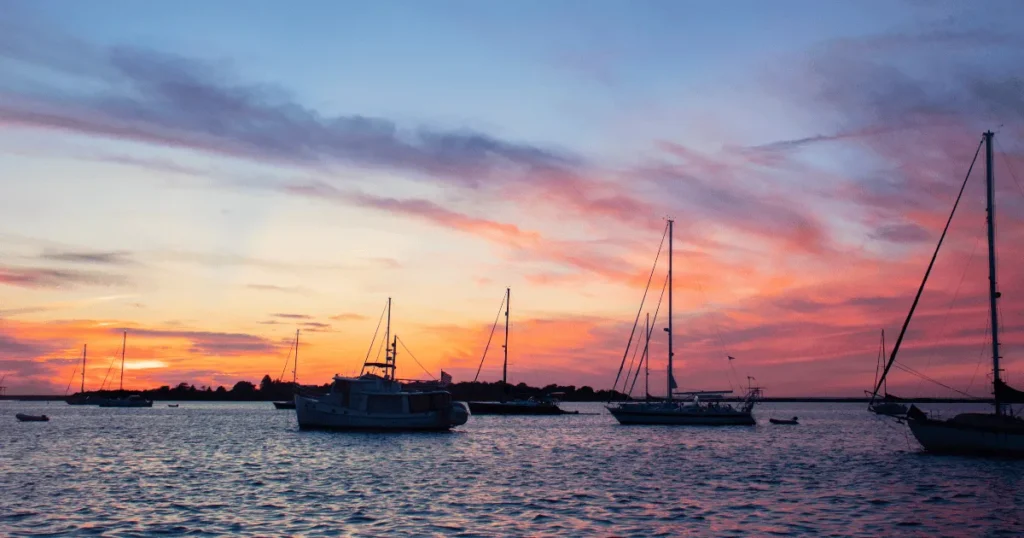
Just after sunrise in Great Salt Pond, before the day-trippers are even on the ferry, the Aldo’s bakery boat motors past the anchored sailboats and somebody on board calls “Andiamo … andiamoooooo!” across the water. Same family. Same call. For decades. A hand reaches over the gunwale of a 38-foot sloop and a paper bag of cinnamon rolls goes up the side, still warm.
You can spend a whole weekend on the Block and never see that. Almost everyone does.
People show up off the noon ferry, do the same six things in the same order — bluffs, lighthouse, bike, beer, beach, ferry home — and head back thinking the island is fine. It is more than fine. It just does not hand itself over to a Saturday afternoon.
So here are the twenty things to do on Block Island that actually earn the day, plus two more that almost made it — sorted by the trip you are taking. The obvious ones, the quiet ones, the summer picks and the October picks, the ones to book ahead and the ones to walk into.
- Before the List — What We're Skipping, and Why
- The Two Things You Came to Block Island For
- What to Do on Block Island Without a Car
- Block Island With Kids: The Two Picks That Actually Land
- Romantic Things to Do on Block Island Without the Try-Hard
- What to Do on Block Island When It Rains
- The Two Things You Can Only Do on Block Island
- The Best Free Things to Do on Block Island
- Block Island Events Worth Building a Trip Around
- Two Things to Do on the Water (And the Ferry Is One of Them)
- Two More That Almost Made the List
- What a Day on Block Island Actually Costs
- The Block Island Most Lists Don't Cover: October Through May
- The Questions You Are About to Search Anyway —FAQs
- One Last Thing About the Block
Before the List — What We’re Skipping, and Why
A short list, before the real one, of things you’ll see on every other Block Island article that aren’t going on this one.
Ballard’s. The big beach club next to the ferry with the four tiki bars and the cover bands. Every listicle calls it a must-do or a snobby skip. It is neither. It is one fine afternoon on a Tuesday before two o’clock, with one frozen drink, and then you leave. Saturday at Ballard’s in August is not the Block. Ay, no — Saturday at Ballard’s in August is a bachelorette party in a borrowed straw hat, and that is a different vacation. If that is your vacation, go enjoy it. Just do not mistake it for the island.
Mopeds. Legal, but banned from every dirt road on the island — which means they cannot reach Black Rock Beach, the back of the Maze, or most of the west side. Which is, conveniently, most of what makes the Block the Block. The accident stories are real. The year-rounders’ feelings about the engine noise are real. Rent a bike. If the hills worry you, rent an e-bike. Your weekend, and Corn Neck Road, will be quieter for it.
Wind Farm boat tours. Block Island has the country’s first offshore wind farm, five turbines a few miles off the south coast, and yes, there are charters that will take you out to see them up close. You do not need to. You can see all five from the cliff edge at Mohegan Bluffs, free, on the same trip you were already taking.
Andy Warhol. He did not have a house on Block Island. His seaside compound was on Long Island, in Montauk. The myth shows up in a lot of Block Island articles. It is not true.
A few words you’ll hear all weekend that nobody puts in a glossary for you. New Shoreham is the legal name of the town — the island is Block Island, but the post office and the town hall say New Shoreham. The Block is what year-rounders call the island. Off-islanders is you. Year-rounders are the ones who stay through February. The Pond always means Great Salt Pond, never Fresh Pond. The Maze is the unmarked sub-trails at Clay Head. The Bluffs always means Mohegan, never anywhere else.
Use them lightly. You’ll sound less like a tourist by lunch.
It just does not hand itself over to a Saturday afternoon.
The Two Things You Came to Block Island For
These are the anchors. Do them in this order on your first day if you can, and the rest of the trip will arrange itself around them.
Mohegan Bluffs and the 141 Steps
The clay cliffs run for about a mile along the southern coast and drop close to two hundred feet straight down to the Atlantic. There is a wooden staircase to the beach. There are 141 steps. Everyone counts. Everyone is wrong by one or two on the way up, because the calves start lying to the brain around step ninety.
The view from the top is the one TikTok sold you. The view halfway down, looking back up at the cliff face with the wind doing something theatrical to the beach grass, is the one you’ll actually keep. The beach at the bottom is cobble and clay. It is not a swimming beach. It is a sit-down-and-listen beach, then climb back up.
The move almost nobody makes: walk a few hundred yards west of the staircase. The crowd thins, and from that stretch you can see all five turbines of the Block Island Wind Farm hanging out in the Atlantic. That is the photograph people pay a charter to go get. From here, it is free.
Where: End of Mohegan Bluffs Road, off Spring Street.
When: Open all the time. Steps slick when wet.
Cost: Free.
Time: 30 to 60 minutes with the staircase.
The move: Four in the afternoon, west of the staircase.
Biking the Island Loop
You cannot really do the Block in a car. The island is seven miles long and three across, and the actual experience is a thirteen-to-fifteen-mile loop on two wheels. Out of Old Harbor, up Spring Street past the Spring House lawn, south on Mohegan Trail to the lighthouse and the bluffs, west on the back roads, north along Corn Neck Road past Crescent Beach, back into town.
Three shops do the job. Aldo’s at 130 Chapel Street is closest to the ferry and runs a free pickup shuttle. Island Moped & Bike is right in Old Harbor. Beach Rose Bicycles is a fifteen-minute walk from town and tends to run a few dollars cheaper. Adult day rates in 2026 sit in the $45 to $95 range. E-bikes available at all three. Take the e-bike.
A detail almost nobody mentions: bikes are allowed on the dirt roads, and mopeds are not. That is how you reach Black Rock Beach, the back of Clay Head, the quiet of the west side. More island, less money.
Where: Aldo’s, 130 Chapel St. Island Moped, 32 Weldon’s Way. Beach Rose, 218 Ocean Ave.
When: Daily in season, shoulder for the first two, summer-mostly for Beach Rose.
Cost: $45–$95/day adult bikes, around $30/day kids’.
Time: Half a day with stops.
The move: Pay the extra ten for the e-bike. Spring Street is steeper than it looks.
What to Do on Block Island Without a Car
You actively shouldn’t bring a car unless you booked the ferry reservation three months out — and even then, you’ll wonder why you bothered. The Block is small. Most of what’s good is within a fifteen-minute walk of the Old Harbor ferry dock.
The Old Harbor Village Walk
Old Harbor is what you see when the ferry pulls in. The big white Victorian hotels with the wraparound porches — the National Hotel, the Hotel Manisses up the hill, the Surf — went up in the late 1800s, when the steamships from the mainland made Block Island a summer destination, and the village still moves at that pace.
Water Street is the main spine. Walk it slowly. The Empire Theatre, an 1882 wood-frame building that started as a roller rink and is now the only movie house on the island, sits about three doors up from the ferry — you’ll come back to it on a rainy day. Spring Street climbs the hill to the south and is where the prettier hotels live. The shops between them are good for an hour. Most close after Columbus Day.
Where: Old Harbor, immediately at the ferry dock.
When: Anytime. Shops May to Columbus Day.
Cost: Free unless you walk into a shop.
Time: An hour, easy. Two with a stop.
The move: Up Spring Street to the porch at the National Hotel, sit in a rocking chair, watch the next ferry come in.
Crescent Beach (Fred Benson Town Beach)
About a ten-minute walk north of Old Harbor up Corn Neck Road, the road bends and Crescent Beach opens out — three miles of soft sand running up the east coast of the island. This is the family beach. It is the only Block Island beach with lifeguards, a bathhouse, snack-bar food, and rinse showers.
Two things worth knowing if you’re walking up from the ferry. This is the protected side of the island — Crescent runs along the east shore, away from the open ocean on the south, which is why it is the family beach and the others aren’t. And the crowd lives in the first half mile from the pavilion. Keep walking north and the beach drifts into Scotch Beach, then Mansion Beach, with no signs to mark the change. By the time you’re a mile up, you’ll have most of the sand to yourself.
Where: Corn Neck Road, half a mile north of Old Harbor.
When: Open year-round. Lifeguards mid-June through Labor Day.
Cost: Free. Chair and umbrella rentals seasonal.
Time: As long as you give it.
The move: Walk twenty minutes north. The crowd thins by the half-mile mark.
Block Island With Kids: The Two Picks That Actually Land
Block Island has exactly one yak, and your kid is going to ask about him for a year. Both of these are walkable from the ferry, and the first one is open in February when almost nothing else is.
1661 Farm & Gardens
Up Spring Street, between the 1661 Inn and the Hotel Manisses, there is a small farm that you cannot quite believe exists on a Rhode Island island. Camels. Kangaroos. Lemurs. Emus. A zeedonk — that’s a zebra-donkey, and yes, it is real. Ay dios. Llamas, alpacas, the yak, Tank the giant tortoise. It is one of only two licensed zoos in the state of Rhode Island.
The story goes it started decades ago with a single llama, and grew from there. The same family has kept it going since — and word around the island is their hand shows up in a few other places on this list, too. You start to notice the thread.
It is free, donation-based, and open dawn to dusk year-round. Feed is sold via an honor box near the gate. That last part — the year-round bit — is the kicker. In February the farm is one of the only things on the island still humming.
Where: 5 Spring Street, between the 1661 Inn and the Hotel Manisses.
When: Dawn to dusk, every day of the year.
Cost: Free. Donations welcome. Feed by honor box.
Time: 30 to 45 minutes. Longer if your kid finds Tank.
Best for: Anyone with a kid under twelve. Animal people of any age.
The move: Go in the morning before the day-tripper foot traffic stacks up at the fence.
Block Island Maritime Institute (BIMI)
About a fifteen-minute walk from the ferry, on Ocean Avenue facing the Great Salt Pond, BIMI is the island’s working educational center — five outdoor tanks of what lives in the pond and the waters around the island, indoor tanks with a jellyfish display and baby chain dogfish, touch tanks where a kid can hold a horseshoe crab. It is not a slick aquarium. It is a marine institute with school-group energy, and that is what makes it good.
The schedule in season is the value. Creature Feature programs run daily and focus on whatever’s currently in the tanks. The Pond tours go out on a historic Oldport launch on set mornings in season — check the day before you plan around it. Tuesday Talks in the evening bring in scientists and ecologists from the region. Pond & Beyond Kayak operates out of the same property, which means you can pair an hour in the tanks with an hour on the water.
Where: 216 Ocean Avenue, New Harbor side. Behind Payne’s Killer Donuts.
When: Wednesday–Monday, 9 AM–4 PM. Tuesdays, 1 PM–4 PM. Seasonal.
Cost: Small admission. Donation-based.
Time: An hour in the tanks. Longer with a program.
Best for: Curious kids four through twelve.
The move: Check the program schedule before you go. Time your visit to a Creature Feature.
Romantic Things to Do on Block Island Without the Try-Hard
The two best moments on the Block happen twelve hours apart, and both are on the water. One at sunrise. One at sunset. You do not need a reservation for either.
The Aldo’s Bakery Pastry Boat at Sunrise on Great Salt Pond
This is the moment from the opening of this article. It is also the one thing on the Block that almost no listicle leads with, and the one I would lead with again.
Aldo’s Bakery has been a family operation on Block Island for decades. Every summer morning, before the day-trippers are even at the Point Judith ferry terminal, a boat with the Aldo’s logo on the side motors out into Great Salt Pond and works its way through the anchored sailboats and motor yachts, selling cinnamon rolls, breakfast sandwiches, coffee, and pastries straight off the gunwale. The greeting comes first — “Andiamo … andiamoooooo!” — called across the water so you know they’re coming. If you’re aboard, you can hail them on the radio. You can also just wait for the call.
If you’re not staying on a boat, the storefront at 130 Weldon’s Way opens at 5:30 in the morning in summer. The cinnamon rolls go early. One important clarification, because every other article gets it wrong: Aldo’s Bakery on Weldon’s Way and Aldo’s Mopeds on Chapel Street are different businesses. Common family origin, separate operations. The bakery has the boat. The mopeds have the loud engines.
Where: Storefront at 130 Weldon’s Way. Boat in Great Salt Pond.
When: Storefront 5:30 AM to 11 PM in summer. Boat: summer mornings.
Cost: A few dollars for a roll.
Time: 20 minutes at the storefront. Sunrise on a boat is its own kind of forever.
The move: If you’re not on a boat, go at six. The rolls are still warm and the line is twelve hours away.
Sunset Cocktails on the Spring House Lawn
About a ten-minute walk up Spring Street from the ferry, on a rise that looks south over the Atlantic, sits the Spring House Hotel — built in 1852, the oldest hotel on the island. The building has a wraparound veranda, a mansard roof, and a wide green lawn that runs from the porch toward the cliff. On that lawn is a row of white Adirondack chairs lined up along the crest, all facing the water.
You do not need to be staying there. You do not need a dinner reservation. You walk up, walk through, walk out the back, find an open chair, and order one cocktail. Twenty-five minutes before sunset is the window. The sky goes from gold to pink to that quiet grey that lasts twelve minutes longer than it should. Most people don’t stay for dinner, and that is fine — one drink, one chair, one hour, done.
Where: 52 Spring Street, ten minutes’ walk from the ferry.
When: Hotel open spring through fall, daily.
Cost: One cocktail, around $15 to $20.
Time: An hour, including the walk back down the hill.
The move: Arrive at half past six in July, half past five in September. Order something with bourbon. Stay until the grey is gone.
What to Do on Block Island When It Rains
Every island gets a rainy day. The Block has two cures for it, and both have been on the same street corners since the 1800s.
The Empire Theatre
Three doors up Water Street from the ferry stands a wood-frame building that has been almost everything a building can be. It was built in 1882 as a roller rink. By 1897 it had become a church. After that, a ballroom, then storage, then a silent-movie house in the early twentieth century. It closed in the 1980s and sat dark until 1993, when it reopened as a movie house again and has been the only movie theater on Block Island ever since.
The projector is now digital. Almost nothing else about the experience is. The wood-frame building creaks. The wind outside finds its way into the rafters during a quiet scene, and on a stormy night that is part of what you’re paying for. Films run at 7:30 in the evening, with a one o’clock matinee on rainy afternoons — which is the entire reason the Empire is on this list.
Where: 17 Water Street, three doors up from the ferry.
When: Seasonal, roughly May through October. Nightly 7:30, rainy matinees at 1.
Cost: A movie ticket.
Time: Two hours.
The move: Go for the matinee on the day the forecast turned. The building is half the show.
Block Island Historical Society Museum
A ten-minute walk inland from Old Harbor, at the four-way intersection of Old Town Road and Ocean Avenue — locally called Bridgegate Square — there is a three-story building with a red mansard roof. It was built in 1871 as a summer hotel called the Woonsocket House. The Historical Society bought it in 1945. It is now the island’s museum.
Two floors of exhibits. Stone tools and points from the Manissean people, who lived on the Block long before the English showed up in 1661. Maritime artifacts and lifesaving displays, including material on the Larchmont — the steamship that sank in February 1907 in a blizzard off the island’s coast with the loss of more than a hundred and forty lives. The Princess Augusta — the wreck that became the Palatine legend — has its own corner. Victorian photography. Quilts. Boat models. The kind of small island museum where the docent will talk to you for an hour if you ask one real question.
Where: 18 Old Town Road, at Bridgegate Square.
When: Memorial Day through Indigenous Peoples Day. Hours scale with season.
Cost: 2025 admission $10 adults, $8 seniors and military, $6 students, free for kids under 12.
Time: An hour. Two if the docent’s in the mood.
The move: Ask about the Larchmont. You’ll get a story no plaque will give you.
The Two Things You Can Only Do on Block Island
Every island has its own thing. The Block has two, and one of them you can literally take home with you.
The Glass Float Project
Somewhere between June and October, on the Greenway trails and just above the high-tide line on the public beaches, there are 550 hand-blown glass orbs hidden across Block Island. Each one is numbered, dated, and signed. If you find one, it is yours to keep.
The rules are specific and they matter. Floats are never hidden in dunes, on the cliffs themselves, or on private property — only on the Greenway trails or above the high-tide line on the beaches. One float per seeker per year. You find more than that, you leave the rest for someone else. If you find one, you register the find online with the Block Island Tourism Council.
The project is the work of one man. Eben Horton, a glass artist from Rhode Island, started it over a decade ago, and he and his team now blow 550 every year. A handful at the start of each batch come out brightly colored; the rest are clear, with the seafoam quality glass takes when the sun goes through it. Most visitors will look for an entire weekend and never find one. Some people find one on their first walk. That is the project working as designed.
Where: Greenway trails and public beaches.
When: Floats placed June through October. Volunteers re-hide stragglers into the fall.
Cost: Free.
Time: An afternoon to a whole vacation.
The move: Walk Clay Head or Rodman’s Hollow at off-hours. Look at eye level, not at your feet.
The Southeast Lighthouse and the 1993 Move
At the top of Mohegan Bluffs, on the same headland you climbed down from on the 141 Steps, stands the Block Island Southeast Lighthouse — a red-brick Gothic Revival tower built in 1874, the highest lighthouse in New England by elevation, and a National Historic Landmark. None of that is the interesting part.
The interesting part is that it is not where it was built.
By the late 1980s the bluffs had eroded out from under the lighthouse to within about seventy-five feet of the foundation. The decision was made to move it. In August 1993, after a decade of planning, three Acts of Congress, and roughly two million dollars, the entire 2,000-ton brick lighthouse was rolled about two hundred forty-five feet inland on rails. It was one of the largest historic-preservation moves in American history at the time. Most people who walk up to the lighthouse on a summer afternoon have no idea the bricks under their feet were not there a generation ago.
The Fresnel lens has a story of its own, too — the kind the museum volunteers will tell you it was salvaged from another lighthouse entirely and given a second life here. A tower with two histories, if the telling holds up.
Where: 122 Mohegan Trail, at the top of the bluffs.
When: Museum and gift shop open in season. Tower tours seasonal.
Cost: Tower tour around $15. Grounds free.
Time: 30 minutes for the museum. 45 with the tower.
The move: Combine it with Mohegan Bluffs. You’re already there.
The Best Free Things to Do on Block Island
Half of what’s good on the Block costs nothing. Both of the next two are walks rather than drives, and both reward the off-season visit as much as the summer one.
The North Light Walk: Settlers’ Rock to Sandy Point
Drive, bike, or take the Old Harbor Bike Path to the end of Corn Neck Road, and you arrive at a small parking lot beside a stone marker. The marker is Settlers’ Rock. It lists the names of the sixteen English families who settled on Block Island in 1661, and it notes — almost in passing — that the families’ cattle had to swim ashore.
From there, you walk. About three-quarters of a mile up the beach, north along the shore, the sand turning to cobble as you go. The lighthouse you can see in the distance is the Block Island North Light, built in 1867 of imported granite blocks, the fourth lighthouse to attempt this particular shifting headland. The walk is harder than it looks because the sand is soft. Keep close to the waterline.
The reward is the silence. The lighthouse sits on Sandy Point, the northernmost tip of the island, with the open ocean on three sides. In February through April, the harbor seal colony hauls out on the offshore rocks — you’ll hear them before you see them. The North Light Interpretive Center has a few rooms of marine history, including material on the Larchmont. One tick warning, and it’s serious: Block Island has Lyme disease. Long pants and a check at the end of the walk.
Where: End of Corn Neck Road, then ¾ mile along the beach.
When: Walk year-round. Interpretive Center seasonal.
Cost: Free. Small admission for the center.
Time: 90 minutes to two hours round trip.
The move: February or March, low tide, in the morning. The seals are the whole show.
Clayhead Trail and the Maze
Off Corn Neck Road, about three miles from Old Harbor, there’s a trailhead opposite a yellow farmhouse. Most people drive past it. The trail runs through 190 acres of Nature Conservancy land along the island’s northeast bluffs, with a main path along the cliff edge and a network of unmarked sub-trails through the shadbush that locals call the Maze.
The Maze is the part. The sub-trails twist through head-high brush, open suddenly onto the ocean, double back on themselves, and feel like a different island than the one the day-trippers are on. In late April there is a field of daffodils that comes up out of nowhere — yellow against green, in the middle of the bluffs. In late September the fall migration moves through and the bird-banding station on the property is in season. The Block sits squarely on the Atlantic Flyway.
One detail almost no one writes about: at low tide, you can walk from the Clay Head beach along the shoreline toward the North Light. It is a quiet coastal stretch that turns the two best free things on the island into one long morning — but the tide is the whole game here. Go on a falling tide, know when the low is, and don’t let a rising one catch you against the cliffs.
Where: Trailhead on Corn Neck Road, ~3 miles from town. Opposite a yellow farmhouse.
When: Year-round. Spring for daffodils. Late September for the migration.
Cost: Free.
Time: Two to four hours.
The move: Low tide, late September, with the Maze loop into the shoreline walk toward North Light.
Block Island Events Worth Building a Trip Around
The Block has a long season and a short one, and the events that bookend each are the ones worth circling on a calendar. One opens the island in May. One closes it in November.
The Storm Trysail Block Island Race (Memorial Day Weekend)
For one weekend at the end of May, Block Island stops being a quiet pre-season island and becomes the finish line for one of the oldest offshore races in the Northeast. The Storm Trysail Club’s Block Island Race started in 1946. The 79th running was May 22–24, 2026. The fleet starts in Long Island Sound off Stamford, rounds Block Island, and finishes back where it began. The big boats cross the line in the dark on Friday night. The smaller ones come in all the way through Saturday.
You don’t have to know anything about sailing to enjoy the weekend. Mansion Beach gives you the broad view. Beane Point is the closer view for the south-side approach. Payne’s Dock in New Harbor is where the energy is — crews coming off boats, the bar full of foul-weather gear, the unofficial start of the season. The Block Island Music Festival follows in mid-June at Captain Nick’s, and ConserFest happens at the Southeast Lighthouse in August. Both are worth knowing about.
Where: Race finish visible from Mansion Beach, Beane Point, Payne’s Dock.
When: Memorial Day weekend, late May.
Cost: Free to spectate.
Time: An evening, or the whole weekend.
The move: Friday night beer at Payne’s Dock, Saturday morning at Mansion Beach.
The Block Island Holiday Stroll (Late November)
The other end of the calendar is quieter and prettier. The Holiday Stroll runs the weekend after Thanksgiving — the 34th annual ran November 28–30, 2025. Water Street is lit. The shops that are still open run the year’s last sales. There’s a gift basket raffle that benefits the island. Both the Traditional and the Hi-Speed ferries run that weekend, which is the only time outside summer you get the Hi-Speed at all.
The reason to come is not the shopping. The reason is what an island village looks like at the end of November, with the lights up and the wind off the harbor and almost nobody around. Stay at the Manisses or the Spring House — they keep rooms open for the Stroll. Eat at Mohegan Café. Walk Water Street at six in the evening when the lights are on and the air smells like cold salt and woodsmoke.
It is the off-season’s signature event, and it is the single best argument for coming back in winter.
Where: Old Harbor, Water Street. When: Friday through Sunday after Thanksgiving.
Cost: Free.
Time: A day, or a weekend.
The move: Friday afternoon ferry, do the stroll at dusk, ferry back Saturday or Sunday.
If the Vineyard is the dinner party and Nantucket is the country club, Block Island is the long walk afterward.
Two Things to Do on the Water (And the Ferry Is One of Them)
You came to Block Island on a boat. Think of the boat as part of the trip, not the price of admission.
The Ferry Itself: Point Judith Traditional vs. Hi-Speed
Most first-timers default to the Hi-Speed without thinking. On a clear summer morning, that is the wrong call.
The Hi-Speed runs from Point Judith to Old Harbor in about thirty minutes, costs $28 one-way per adult after the Rhode Island PUC rate increase that took effect in June 2024, carries no cars, runs summer only, and is enclosed. It is the move when the weather looks unstable, when you’re day-tripping and every minute counts, or when the kids will not tolerate an hour on a boat. On a calm August morning, the Hi-Speed is a fast bus across the water.
The Traditional ferry runs the same route in about fifty-five minutes, costs around $18 one-way per adult per current 2026 fares, takes cars (if you booked months ahead), takes dogs, and has an open top deck with bench seats and a snack bar that sells hot dogs and beer. The top deck on a calm morning is the better trip. The town shrinks behind you. The wind picks up. The island appears as a long low line of green. By the time you can see the bluffs from the water, you are already on vacation.
Where: Point Judith ferry terminal, Galilee, Narragansett.
When: Traditional year-round. Hi-Speed summer only.
Cost: Traditional ~$18 OW adult, 2026. Hi-Speed $28 OW adult, per RI PUC June 2024.
Time: 55 minutes Traditional, 30 minutes Hi-Speed.
The move: Traditional out on a calm morning, top deck, hot dog. Hi-Speed back if the wind picks up.
The Oar at New Harbor
On the New Harbor side of the island, at the Block Island Boat Basin on Great Salt Pond, there is a casual restaurant called The Oar with a ceiling that is the entire reason to go.
Decorated oars hang from the rafters by the hundreds, signed and painted by the boaters who brought them in over the years. The tradition is real — bring a decorated oar to the front desk, and they will hang it. Some families have a whole row of them up there from a decade of summers. The restaurant itself does casual American food, has a sushi menu, and is known for a frozen Mudslide that locals have their own way of ordering. Closed in winter.
The Oar runs in the same family orbit as a couple of the other places on this list — the kind of overlap you start to notice once you’ve been on the island a few days. The energy on a July evening, with the Salt Pond going pink behind the deck, is the version of Block Island the day-trippers never see.
Where: 221 Jobs Hill Road, at the Block Island Boat Basin.
When: Lunch and dinner, in season. Closed in winter.
Cost: Mid-range. Mudslide around $20.
Time: An evening.
The move: Sunset on the deck, frozen Mudslide, ceiling above you.
Two More That Almost Made the List
Rodman’s Hollow
Off Cooneymus Road, on the south side of the island, there is a glacial bowl that drops below sea level. It is 230 acres of unmaintained meadow, shadbush, and stunted trees, and it is the first piece of land that was ever conserved on Block Island. In 1972, the community made the decision to protect it from development. Everything that followed — the Greenway trail system, the conservation easements, the fact that more than forty percent of the island is now preserved — started here. Rodman’s Hollow is the reason Block Island looks like Block Island.
A word on Black Rock Beach at the end of the trail. The descent is rope-assisted and most visitors skip it. The beach is sometimes referenced online as clothing-optional, and the honest answer is that Rhode Island public nudity law applies and the Town of New Shoreham does not designate any beach as such. De facto remote, not officially clothing-optional. Plan accordingly. The tick warning from the North Light walk applies here twice over.
Where: Trailhead off Cooneymus Road and Black Rock Road.
When: Year-round. Spring for the shadbush bloom.
Cost: Free.
Time: Two hours round trip.
The move: Late May, late morning, with the scramble down to Black Rock Beach if you have the knees for it.
Mansion Beach
Walk Crescent Beach to the north long enough and it becomes Scotch Beach, and then Scotch becomes Mansion. There are no signs. The crowd thins by the half-mile mark. The sand widens, the surf builds — Mansion has the strongest break on the island — and at one point in the dune grass you start to see foundations. Stone steps that go nowhere. Cement piers half-buried in beach grass.
Those are the remains of the Searles Mansion, a Gilded Age summer estate that burned down in 1963 and was never rebuilt. The bones of the foundation are still there. The beach itself runs about three miles up the east side from where Crescent ends, and at low tide on a September weekday it is one of the quietest places on the island.
This is the upgrade to Crescent. Same beach, technically. No facilities, fewer people, better surf, more story.
Where: Mansion Road off Corn Neck Road, about 2.5 miles from Old Harbor.
When: Year-round.
Cost: Free.
Time: A long afternoon.
The move: Late September afternoon, walk up from Crescent, find the foundation stones, stay until the light goes.
What a Day on Block Island Actually Costs
A day on the Block costs more than you’d think a day on a seven-mile island should cost — and most articles don’t say so. Here is the math for one adult on a regular summer day.
The ferry. Round-trip from Point Judith, the Hi-Speed is $56. The Traditional is around $36. Park at the Galilee terminal lot and add another $15 to $20. Call it $50 to $75 just to get there and back.
Getting around. An adult bike rental runs $45 to $95 a day in 2026. E-bike higher. A taxi runs around $11 for a one-and-a-half-mile ride or $20 to cross the island.
Food. Coffee and a pastry: $7 to $12. Lunch sandwich and a drink: $20 to $30. Dinner at a sit-down restaurant — Eli’s, Kimberly’s, the Spring House Bistro, The Oar — runs roughly $40 to $70 a person before alcohol, with higher-end menus pushing entrees into the $35 to $55 range. The Mudslide at The Oar is around $20. The Mudslide at Ballard’s is around $20 and comes with a different kind of afternoon.
One paid activity. Lighthouse tour, $15. Historical Society museum, $10. Kayak rental from Pond & Beyond, hourly. Fishing charter, several hundred dollars.
Total for one adult, ferry to ferry, with one sit-down dinner: $150 to $250 a day. That number is honest, and it is the reason every line on this article pairs a paid item with a free one. You can do the Block on the bottom end by biking, eating one real meal, and spending the rest of the day on Mohegan Bluffs and the Clay Head trail. You can also spend twice that without trying. Both are real Block Island days.
The Block Island Most Lists Don’t Cover: October Through May
The Block has a second life from October to May that almost nobody writes about, and it is the one I would send a friend to first. The crowds are gone. The day-trippers are gone. The cinnamon-roll line is gone.
What is left is the island the year-rounders actually live on. It is the better version.
Here is the month-by-month, because the off-season is not one season — it is six different ones.
October — the best month on the island, full stop.
The summer crowd is gone by Columbus Day. The Glass Float Project volunteers are still placing and re-hiding orbs through the end of the month, which means October hikers have better odds than August day-trippers.
The fall migration moves through Clay Head and Rodman’s Hollow — peregrine falcons, songbirds, the largest gull colony in Rhode Island staging on the south shore. Most restaurants are still open through Columbus Day weekend. Ferry service is full.
Rent a cottage for a long weekend and you will wonder why anybody comes in August. Te lo juro.
November — quieter.
Most restaurants close by mid-month. The Holiday Stroll the weekend after Thanksgiving is the one event worth building a trip around. Both ferries run that weekend, which is the only off-season weekend you get the Hi-Speed.
The light gets low and gold by three in the afternoon. Wear a real jacket.
December — the island is mostly shut.
Mohegan Café, Kimberly’s, and Block Island Grocery are typically open in some capacity. The 1661 Inn stays open year-round — one of the few places that does. The breakfast buffet is seasonal, but the Inn itself running in December is the kind of detail that gives the off-season any structure at all.
January and February — the quietest the island gets.
The Traditional ferry runs two to four round-trips a day depending on weather. Most things are closed.
What is open is the farm at 1661 — Tank the tortoise is in winter quarters, but the camels and the yak are not — and the harbor seal colony at Sandy Point. The seals haul out on the offshore rocks at the North Light from roughly February through April.
You hear them before you see them. Bundle up. Walk slowly. The light is colder than you expect.
March — the shoulder begins.
Restaurants start announcing reopening dates. The seal colony is still out. The wind off the Atlantic cuts straight through a coat, and you’ll want a windproof shell instead.
By the end of the month, the daffodils at Clay Head are starting to think about coming up.
April — the daffodils open.
Late April is the window for the daffodil field at Clay Head — yellow on green, in the middle of the bluffs, almost nobody there. The 1661 Farm gets active as the lambs and chicks come in. The Traditional ferry adds round-trips.
By the last weekend, the island is waking up.
May — the season opens.
Most restaurants reopen by Mother’s Day weekend. The Historical Society opens late May. The Storm Trysail Race runs Memorial Day weekend and the Salt Pond fills with boats.
By the end of the month, you are essentially in summer — only without the crowds.
One practical note. Winter on the Block is not a tourism product. Restaurants close on short notice. Ferry runs cancel for weather. The grocery store keeps shorter hours.
If you come in February, you are not visiting an island that has its winter face on for you. You are visiting an island that is doing what it does, and you are welcome to be there.
That is the point. That is the version of the Block that most people never see, and it is the one you will remember the longest.
The Questions You Are About to Search Anyway —FAQs
Here are the eight questions everybody types into Google before booking the ferry, answered without making you click through eight tabs.
How do you get to Block Island?
Four ferry routes, plus a tiny airline. The year-round option is the Point Judith Traditional from Galilee in Narragansett, about fifty-five minutes. The summer-only Point Judith Hi-Speed runs the same route in about thirty. The seasonal Newport ferry runs May through early fall. The seasonal Block Island Express from New London, Connecticut runs late May through Columbus Day. New England Airlines runs a small commuter flight from Westerly State Airport that lands at Block Island State Airport in about twelve minutes, year-round. Most first-timers take the Point Judith ferry, and they should.
How much does the ferry cost?
Round-trip from Point Judith, Hi-Speed runs $56 per adult after the June 2024 RI PUC rate increase. Traditional runs around $36 per adult at 2026 fares. Parking at the Galilee terminal lot is another $15 to $20. Kids and bikes are cheaper. Cars are dramatically more — and they sell out months in advance.
How long do you need on Block Island?
One full day is the minimum to do it justice. Two to three nights is the right answer for a real visit. Day-tripping is possible — most of the SERP is written for it — but the best parts of the island happen at sunrise and sunset, and a day-tripper misses both.
Should you bring a car?
No. The Traditional ferry takes cars, but vehicle reservations sell out months in advance and the island is small enough that a car is more friction than freedom. Rent a bike. Walk the village. Take a taxi for the longer hauls. The car-free version of the Block is the better version, full stop.
Is Block Island worth the trip?
Yes, with one honest caveat. It is worth it if you are coming for the island the year-rounders live on — the bluffs at four in the afternoon, the bakery boat at sunrise, the Holiday Stroll in November, the seals at Sandy Point in February. It is not worth it if you are coming for a beach you could get on the mainland for half the price. The ferry math only makes sense when you treat Block Island as the destination, not the backdrop.
What is Block Island famous for?
Mohegan Bluffs. Two lighthouses — the Southeast that was moved inland in 1993, and the North Light at Sandy Point. A conservation ethic that has protected more than forty percent of the island. The Glass Float Project. And a long sailing history that comes to a head every Memorial Day weekend with the Storm Trysail Race.
Are mopeds banned on Block Island?
Restricted, not banned. Mopeds are not allowed on the island’s dirt roads, which is most of the network that reaches the quieter parts of the Block. They are legal on the paved roads. The year-rounders’ position on them is well-known, and the accident stories on Corn Neck Road are real. Rent a bike or an e-bike. The full breakdown is up at the top.
How does Block Island compare to Martha’s Vineyard and Nantucket?
Smaller. Quieter. Less expensive than either, though not by as much as you would hope. The Block is roughly a tenth the size of the Vineyard, with a year-round population under fifteen hundred. It does not have the celebrity weight of the Vineyard or the cobblestoned old-money architecture of Nantucket. What it has is conservation land, an actual local feel, and a ferry that costs less than half of what those islands charge. If the Vineyard is the dinner party and Nantucket is the country club, Block Island is the long walk afterward.
One Last Thing About the Block
The light on the Block does the same thing at the end of the day that it does at the start — goes weird, goes gold, then goes that quiet grey that lasts about twelve minutes longer than it should. If you are lucky enough to be sitting somewhere with a drink when it happens, on the Spring House lawn or the deck at The Oar or the top of Mohegan Bluffs with the wind farm out beyond the cliffs, you understand why people keep coming back to this island for forty years.
The thing nobody puts in the listicles is that the Block does not actually reward planning. It rewards showing up. The bakery boat will be in the Pond at sunrise whether you set an alarm or not. The seals will be on the rocks at Sandy Point in February whether anybody is there to watch them or not. The daffodils at Clay Head will come up in late April. The light will go grey. The Block is doing what it does.
Your job is just to be on the right ferry.
If you only have a day, do Mohegan Bluffs and the bike loop. If you have a weekend, add the bakery boat at sunrise and the Spring House lawn at sunset. If you come back in October, walk Clay Head into the migration. If you come back in February, walk to the seals.
The first time you go, you’ll think you’ve seen it. The second time, you’ll find what you missed. The third time, you’ll start using the word the Block without noticing.
Anyway.
Pingback: 9 Unique Things to Do on Block Island, RI (Beyond the Greatest Hits) - restlesssole.com
Pingback: 11 Things to Do on Block Island When It Rains (An Honest, All-Season Guide) - restlesssole.com